Developer ExperienceWork-stealing for CI

Ferran Basora

David Morcillo
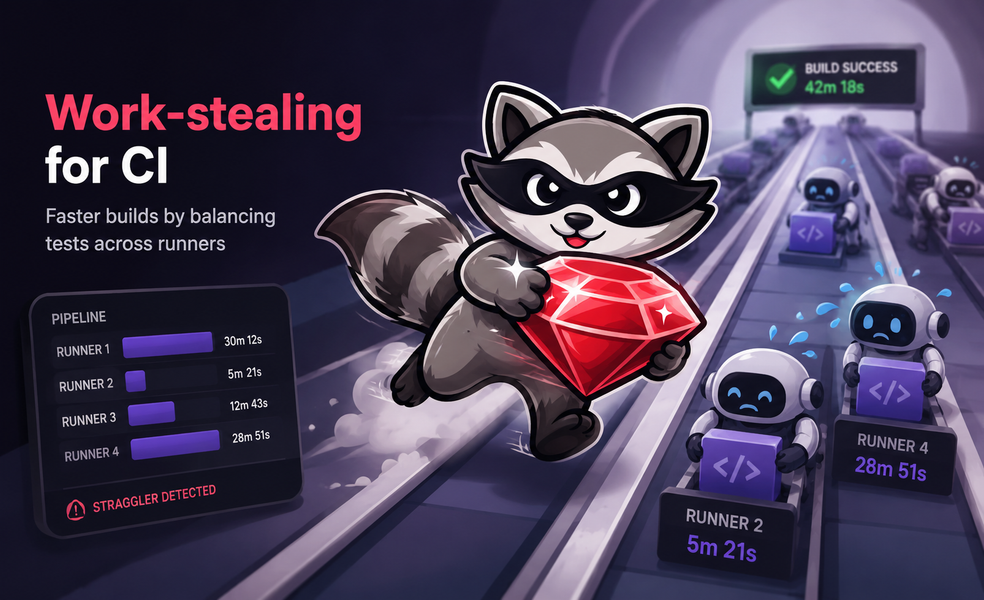
Your test suite keeps getting slower. What used to take 5 minutes now takes 30. You add more parallel runners and split tests statically across them. It helps, but one runner always finishes last while the others sit idle. This is the straggler problem.
The standard fix is to collect timing data from previous runs and use it to distribute files more evenly. Some tools do this with a knapsack-style algorithm: given N workers and a set of files with known durations, pack them into N bins so that the heaviest bin is minimized. It's a solid approach in theory. In practice, it requires collecting and storing timing data somewhere, keeping it fresh, and hoping that last run's timings are a good predictor of this run's timings. They often aren't. A test that took 2 seconds yesterday might take 15 today because someone added a new factory. The database gets slow on a particular CI machine. The timing file goes stale over a holiday weekend. You end up building infrastructure to maintain infrastructure.
There's a simpler way. And it's been around since 1995.
Work-stealing
Work-stealing is one of those ideas that keeps showing up in computer science because it just works. Instead of deciding upfront who does what, you put all the work in a shared pile and let workers grab from it whenever they're free.
The pattern first appeared in Cilk for parallel computation, and spread quickly because the results were so good. Java's ForkJoinPool, Go's goroutine scheduler, Intel TBB, and Tokio (Rust's async runtime) all use variants of it.
Why does everyone keep reinventing this? Because it has a beautiful property: self-balancing. Fast workers naturally take more work. Slow workers take less. Everyone finishes at roughly the same time. No prediction needed. No historical data needed. No bin-packing needed.
The key insight for CI: all workers finish at roughly the same time. No stragglers. No idle machines burning money.


Applying this to CI
specbandit takes this pattern and applies it to test execution. The design is deliberately minimal.
Before any workers start, a "push" step collects all test file paths, shuffles them, and puts them into a shared queue. The shuffle matters more than you'd think. Without it, files tend to be pushed in directory order, which often means slow integration tests end up clustered together at the tail of the queue. Whichever worker happens to steal those last batches gets an unfairly heavy load. Shuffling breaks up these clusters so that slow and fast files are spread randomly. Simple trick, big difference.
Then N workers (your CI matrix jobs) start in parallel and begin stealing batches of files from that queue.
The only technical requirement worth mentioning is atomicity. When multiple workers reach into the queue simultaneously, each one must get a distinct set of files. No duplicates, no gaps. The queue backend provides this guarantee out of the box, meaning concurrent workers will never receive the same file. This single property is what makes the whole thing work without locks, coordination protocols, or any of the distributed systems headaches you'd normally expect.
Workers keep stealing batches until the queue is empty. If a batch fails, the worker records the failure and keeps going. It doesn't block other workers or leave unconsumed files behind.
That's... pretty much it. No leader election. No distributed state. No timing databases. Just a shuffled list and an atomic pop.
Open source, two flavors
specbandit is open source and availble in two languages:
- Ruby: github.com/factorialco/specbandit. Native RSpec support (runs specs in-process, no subprocess overhead) plus a generic CLI adapter for any test runner.
- Node.js: github.com/factorialco/specbanditjs. Dedicated Jest and Cypress adapters, plus a generic CLI adapter for tools like Vitest.
Both use the exact same protocol. Pick the one that matches your stack.
The numbers
After adopting specbandit, we saw a ~25% reduction in wall-clock CI time. Nice. But the more interesting metric is efficiency.
CI efficiency can be defined as:
1
efficiency = total_test_time / (num_workers × wall_clock_time)With static splitting, efficiency drops because of the straggler effect. If you have 4 workers and one takes twice as long as the others, three workers sit idle for half the run. Your eficiency might land around 60-70%.
With work-stealing, all workers stay busy until the queue is drained, and they finalize at nearly the same time. Efficiency approaches the theoretical maximum.
Here's what the change looks like in practice:

Same total work. Better distribution. All workers finishing together instead of three waiting for one.
Not everything is beautiful
Of course, there's a tradeoff. The shared queue is backed by Redis, which means Redis becomes your single point of failure. If it goes down mid-run, workers can't steal and your CI stalls. This is a real concern, but a solvable one. You can roll out high-availability mechanisms (sentinel, clustering) to make it always available. In practice, a managed or well-configured Redis instance is reliable enough that this rarely becomes an issue.
At Factorial we have a self-hosted CI cluster with more than 100 machines. At that scale, efficiency and reliability aren't nice-to-haves, they're essential. specbandit helps us keep all those machines busy and finishing together instead of wasting cycles waiting on stragglers.
Conclusion
Work-stealing has been battle-tested across decades of parallel computing. From parallel runtimes to goroutine schedulers to your CI pipeline, the pattern naturaly fits anywhere you have uneven work and multiple consumers.
If your CI has the straggler problem (and let's be honest, it probably does), give specbandit a try. Sometimes the best solutions are the boring ones.